A Visit to École Polytechnique, France's Elite STEM Institution
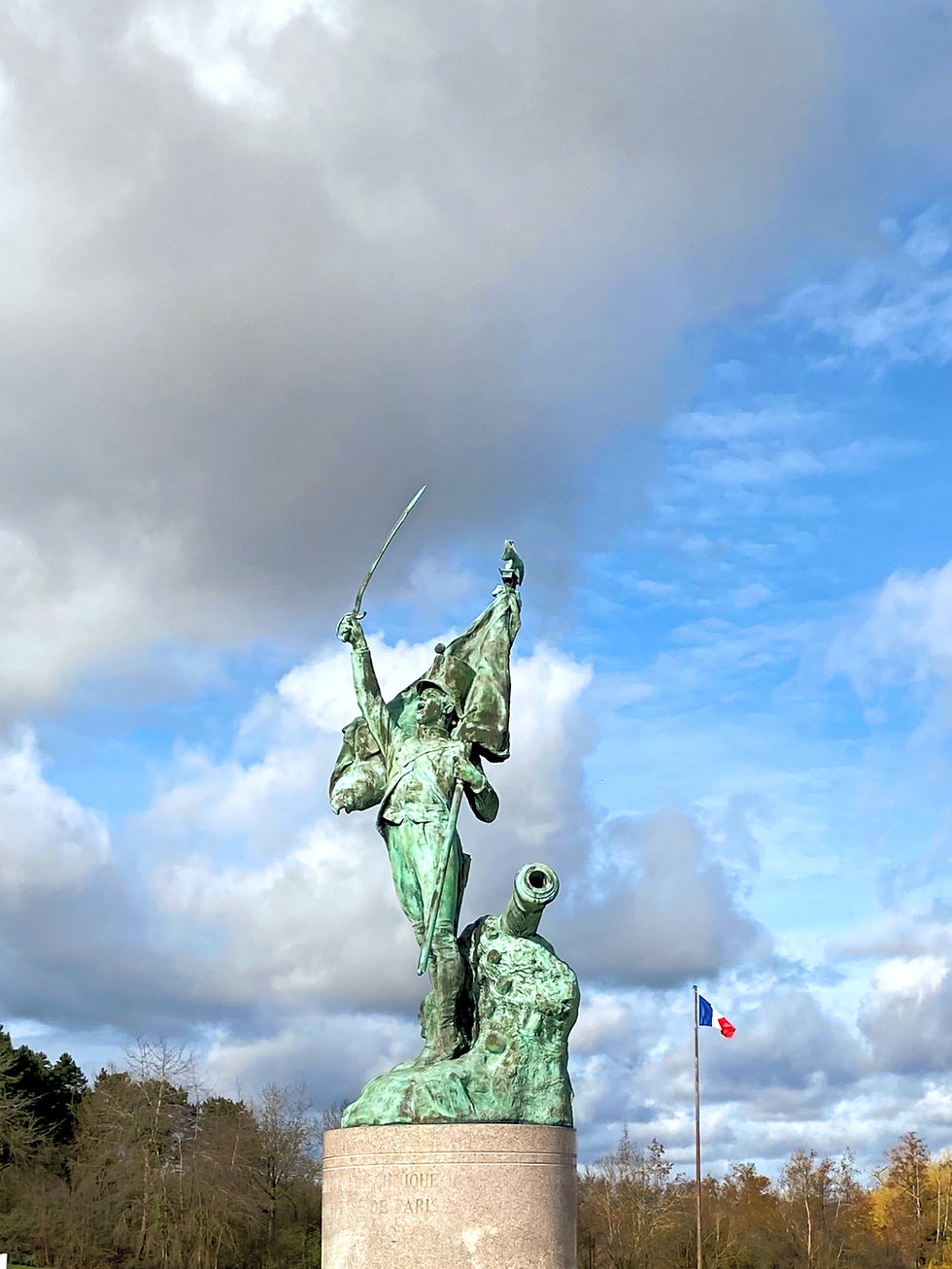
On a chilly Monday in February I visited the École Polytechnique campus situated in a landscape of gentle hills and leafless trees overlooking a lake shaped like Napoleon's bicorne hat in Palaiseau, just outside of Paris. As I roamed France’s elite institution for STEM education, I saw students braced against the chilly wind, some uniformed in fatigues, making their way about the sprawling campus. The campus spaces told a story of innovation echoing from different decades. I observed many old versions of “new”, reflected in campus buildings and interiors. Much of the architecture gave me the feeling of being on a sci-fi movie set from the 70s. It is no wonder, as École Polytechnique has a long tradition of teaching and research since its foundation at the close of the Enlightenment Age. It has been cutting edge for a long time.
École Polytechnique was founded in 1794, with the mission “to provide its students with a well-rounded scientific education with a strong emphasis in mathematics, physics, and chemistry” to help build the new French republic. Founded as a military academy, Polytechnique remains under the umbrella of the French Ministry of Armed Forces. Domestic students undergo military/civil service and wear ceremonial military uniforms (complete with a sword) for major events like Bastille Day.
Informally, the university is called L’X (sort of pronounced “leeks”), a term steeped in the school’s strong military and mathematics heritage. The symbolism of the X ties back to heraldry with crossed cannons and the algebraic x.

Graduates have dominated the leadership of French scientific research, top tech ventures, government, and CAC 40 executive boards. The institution maintains a long history of illustrious alumni including mathematician Henri Poincaré, automotive pioneer Andre Citroen, former President of France Valéry Giscard d'Estaing, and several Nobel Laureates. LVMH CEO Bernard Arnault and former CEO of Nissan and Renault Carlos Ghosn studied at L’X.
Palaiseau is located in the western suburbs about 20km from Paris, and is rapidly developing as an innovation and technology hub for France. The Palaiseau and Saclay region is one of Europe’s important science and technology clusters, driving much of France’s research and development activity. The region hosts more than 60,000 students from around the world, and is a major R&D hub for global corporations like Thales, Danone and EDF, and many tech start-ups and incubators. Some call it France’s Silicon Valley.
L’X is one of France’s grandes écoles, and consistently ranks #1 among French écoles d'ingénieurs (engineering and applied sciences schools) across national tables like L'Usine Nouvelle, L'Étudiant, and Le Figaro. L’X offers two interdisciplinary programs of undergraduate study, as well as advanced degrees and executive education programs.
French-taught Program
The program at L’X is interdisciplinary, with a founding in pure and applied mathematics, and covers computer science, and data science. The 4-year Ingénieur Polytechnicien Program is taught in French and culminates in a Masters of Engineering, Science and Technology.
Entry to the Ingénieur Polytechnicien is a highly competitive two-stage process that includes an entrance exam. Traditionally, candidates spend two years in intensive preparatory classes (classes préparatoires) to take the entrance exam. Admitted students are widely viewed as the top mathematical and scientific minds of their cohort.
English-taught Program
The Bachelors of Science is a 3-year, English-taught program in which students choose one of three double-major tracks, Math and Physics, Math and Computer Science, or Math and Economics. Year 1 is a common academic foundation with students choosing their track by May. The Bachelor of Science cohort is 60% international coming from multicultural backgrounds and more than 100 high schools around the world.
Students who have developed a deep interest in, preparation for, and comfort level with abstract and conceptual ideas will be better matched for Polytechnique’s theoretical approach to study and research. The vast majority of Bachelor of Science graduates go onto pursue advanced degrees, well-prepared for a wide variety of academic areas.
The Global Engineering BS/MS with Columbia University is an interdisciplinary STEM program focusing on solving global issues including artificial intelligence, sustainability, climate change, and resource management. The highly competitive English-taught program begins with the three-year Bachelor of Science at L’X and culminates with the final three to four semesters at the Fu Foundation of Engineering and Applied Science at Columbia University in New York. Alignment to Columbia’s 13 masters programs is dependent on the track chosen during the BS, and interested candidates should choose accordingly. Promotion to the masters at Columbia is not guaranteed, but rather based on academic performance and project requirements while at École Polytechnique.
Admission to the Bachelors of Science is extremely selective and involves a holistic review of academic achievement in general, and evidence of preparedness in math and science in particular. Academic preparedness means an applicant's are expectated to have high achievement in advanced-level maths study (level of AP Calculus BC or IB Math AA at high level) and sciences, in addition to overall strong academic achievement in high school. An admission reader on my visit shared her advice for how to guide potential applicants. She said, “a passion for STEM needs to be screaming from the transcript”.
Applicants from the Brazilian national curriculum would need evidence of high achievement in advanced maths beyond the math level customarily offered at secondary schools across Brazil.
Non-academic factors such as “sustained achievement in any field of intellectual or creative endeavor; accomplishments in extracurricular activities such as performing arts or athletics, scientific competitions, internships, leadership in your school or community, volunteering” are evaluated. Admission requirements also include two letters of recommendation, and applicants are invited to an evaluative interview. The required level of English proficiency is C1.
Campus Life
With its military presence, the campus is very safe. There are more student life resources than is customary at other French universities and include sports facilities, an equestrian center, and on-campus housing. Only one-third of the 3700 students are female. The school acknowledges its discrepancy in gender balance, and has put into place an action plan "fostering a positive momentum towards gender equality".
The day-to-day campus vibe is academic intensity but, students do venture to Paris on the weekends. The trip to Paris from L’X will be much easier starting in November 2026 when the Grand Paris Express will open, connecting to the Massy-Palaiseau hub to Christ de Saclay, with a dedicated stop at the École Polytechnique campus. Further plans to expand connection to the region include a line to Paris Orly airport in 2027.
If you would like to learn more about my visit to École Polytechnique, please contact me here.


Comments